

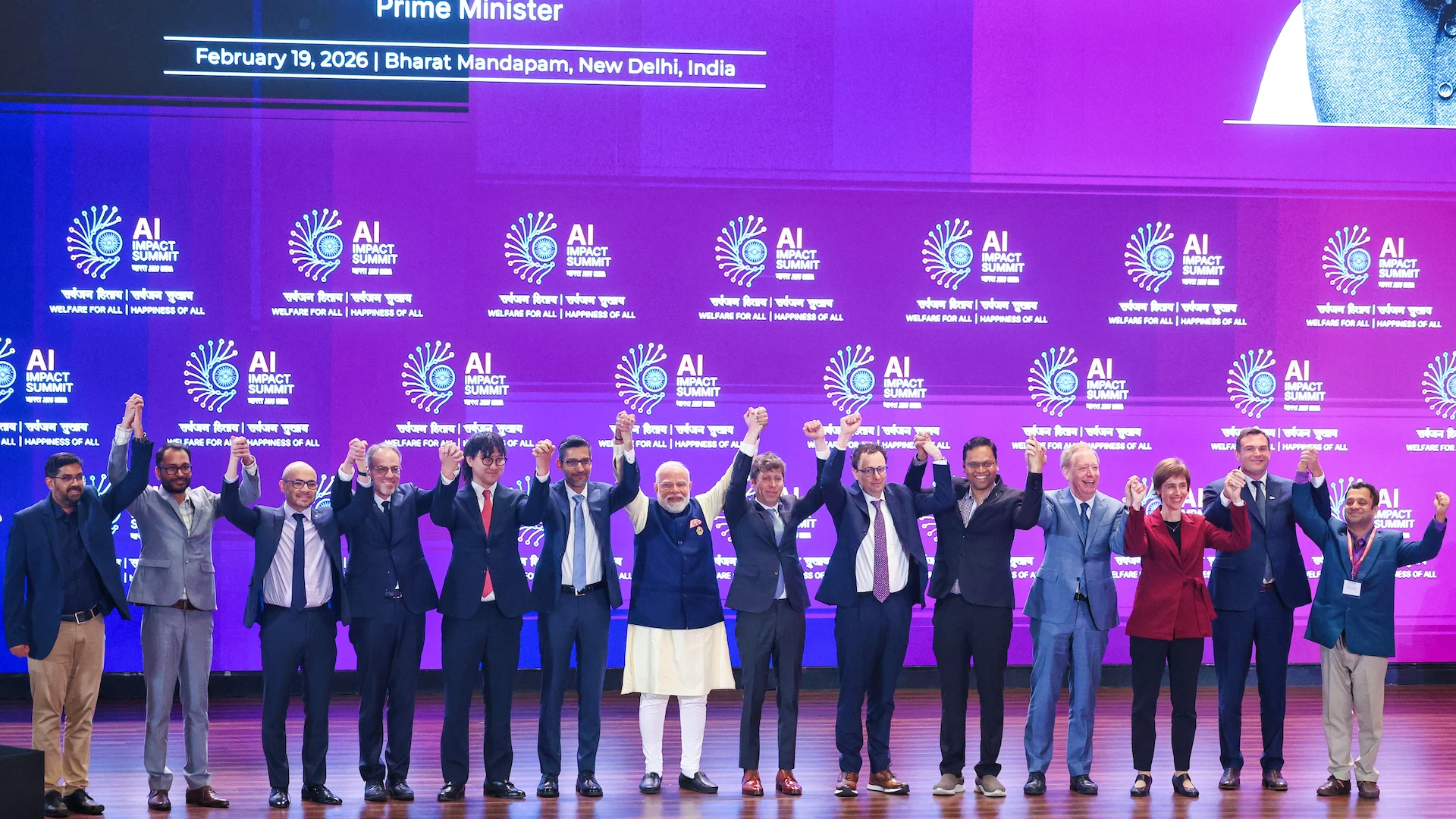
For six days in February, Bharat Mandapam was more than just a convention centre. It stood as a symbol of purpose.
The India AI Impact Summit 2026, held from February 16 to 21 in New Delhi, was the fourth in a series of global AI summits that started at Bletchley Park in 2023, then moved to Seoul in 2024 and Paris in 2025. This summit, however, had a special significance. It was the first time a developing country hosted the event.
And India ensured the world took notice.
More than 20 heads of state attended. Over 500 technology CEOs filled the halls. Delegations from 88 countries signed on to discussions. Prime Minister Narendra Modi inaugurated the summit, joined by France’s President Emmanuel Macron and UN Secretary-General António Guterres. Technology Minister Ashwini Vaishnaw called it a “grand success” that instilled global confidence in India’s AI leadership.
The theme — “Sarvajan Hitaya, Sarvajan Sukhaya” (Welfare for all, Happiness for all) — framed artificial intelligence not merely as a commercial race but as a moral project. Modi’s message was direct: AI must remain human-centric. Without safeguards, he warned, “humans are just data points.” AI should have “an open sky,” he said — but “the command must remain in our hands.”
This perspective shaped the summit, but its historic significance lay in its financial, geopolitical, and technological scale.
The Investment Surge
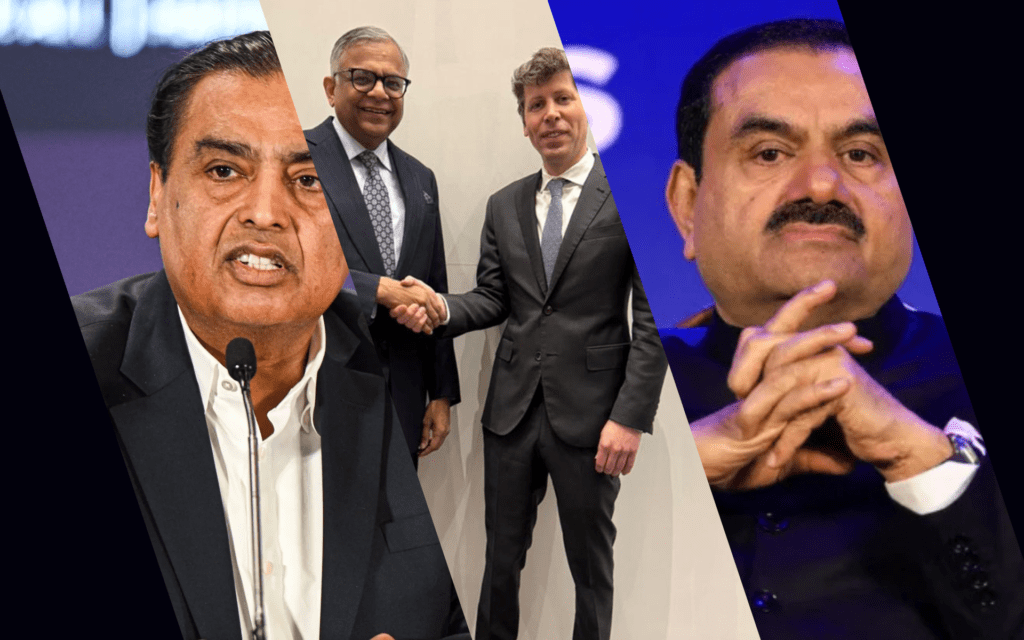
If ambition had a number, it was somewhere between $200 billion and $400 billion.
That was the government’s projected AI investment inflow over the next two to five years. Minister Vaishnaw went further, suggesting that well over $400 billion across the full AI stack could materialize within two years.
Corporate India responded boldly.
Mukesh Ambani’s Reliance Industries pledged up to ₹10 lakh crore — roughly $120 billion — over seven years to build AI infrastructure. His words were characteristically sweeping:
“Jio connected India to the internet era. Jio will now connect India to the intelligence era.”
He added that India “cannot afford to rent intelligence,” signaling a push for domestic compute sovereignty — and promised to slash AI costs the way Jio once cut mobile data prices.
Gautam Adani followed with a $100 billion commitment by 2035, focused on renewable-powered AI data centres. Microsoft confirmed $50 billion by 2030 to expand AI capabilities in emerging markets. Google’s Sundar Pichai announced $15 billion for India’s AI infrastructure, including undersea cables to strengthen data bandwidth and resilience.
Financial capital moved fast as well. Blackstone acquired a majority stake in Neysa, a power-AI startup, for $600 million.
OpenAI’s announcement was among the most consequential. Sam Altman revealed “OpenAI for India,” partnering with Tata Group to build 100 megawatts of AI data centre capacity — scalable to 1 gigawatt — within India to comply with new data residency rules. He also disclosed that India now has over 100 million weekly ChatGPT users, second only to the United States.
In short, boardrooms did not come to Delhi for optics. They came ready to commit capital.
Diplomatic and Strategic Alignments
The summit was not only about funding; it was about alignment.
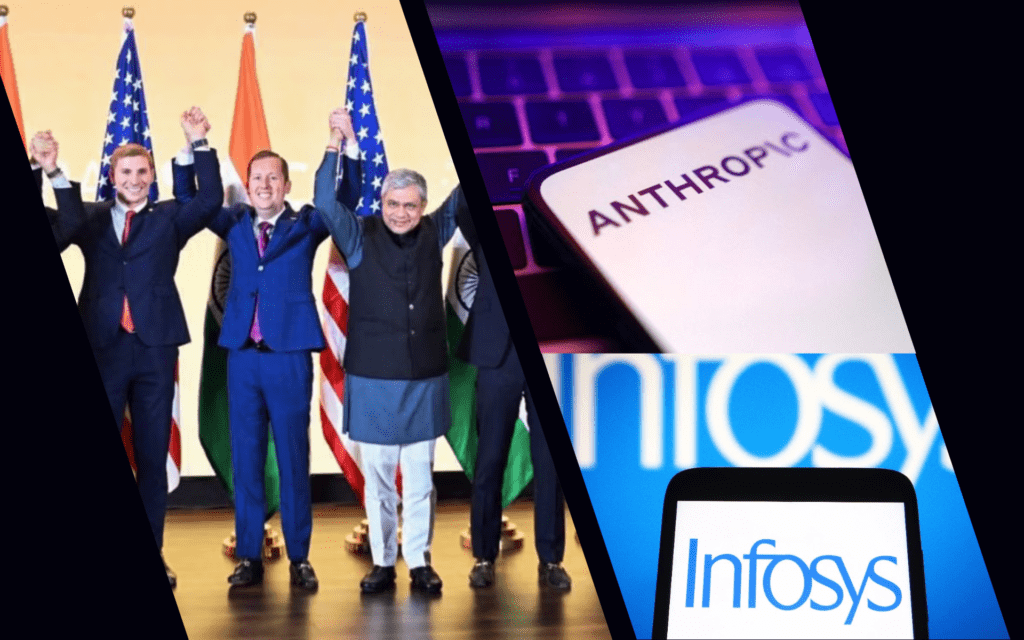
India formally joined the U.S.-led Pax Silica coalition on AI and critical minerals, positioning itself clearly within emerging technology blocs. Eighty-eight countries signed the New Delhi AI Declaration, committing to ethical, human-centric AI development.
Bilateral collaborations expanded rapidly. India and Finland agreed to cooperate in AI, quantum technologies, and space. India and the UK strengthened coordination around 5G, 6G, and Open RAN standards. Switzerland, Lithuania, and the Netherlands discussed AI governance mechanisms — accountability, explainability, regulatory frameworks.
Infosys announced a partnership with Anthropic to deploy Claude AI models across telecom, finance, and manufacturing sectors. AMD and TCS unveiled India-based AI infrastructure plans. Sarvam AI formed alliances with Qualcomm, HMD, and Bosch to bring on-device AI capabilities to consumers. Cohere Labs released multilingual models covering more than 70 languages.
The message was clear: India was positioning itself not merely as a market, but as an ecosystem node in global AI governance and infrastructure.
Showcasing Indian Innovation
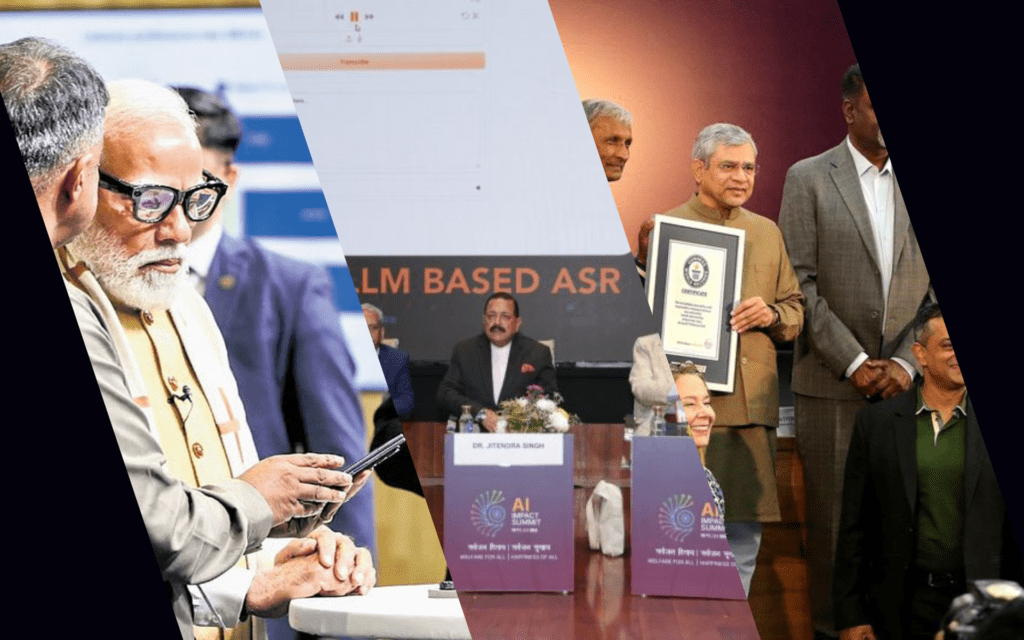
The summit’s exhibition floor was designed to reinforce one idea: India builds.
Sarvam AI unveiled 30-billion and 105-billion parameter large language models built on a Mixture-of-Experts architecture, along with speech and vision models. It also demonstrated “Kaze,” AR smart glasses that Prime Minister Modi personally tested.
The government-backed BharatGen Param2 — a 17-billion-parameter multilingual model covering all 22 official Indian languages — was launched as a symbol of linguistic inclusion.
Startups unveiled tools reflecting India’s unique needs:
Gnani introduced a zero-shot voice-cloning text-to-speech system for 12 Indian languages.
Tech Mahindra revealed an 8-billion-parameter Hindi model for education.
Jio announced plans to integrate ChatGPT features into Hotstar content discovery.
Sarvam also teased “Indus,” a multilingual conversational AI platform.
The government pledged to add 20,000 GPUs to its existing national compute portal of roughly 38,000 GPUs. It also set a Guinness World Record with 250,946 pledges to its AI responsibility campaign.
The emphasis on multilingual AI, local compute, and AI safety institutes pointed toward a long-term strategy of digital sovereignty.
Voices of Optimism — and Warning
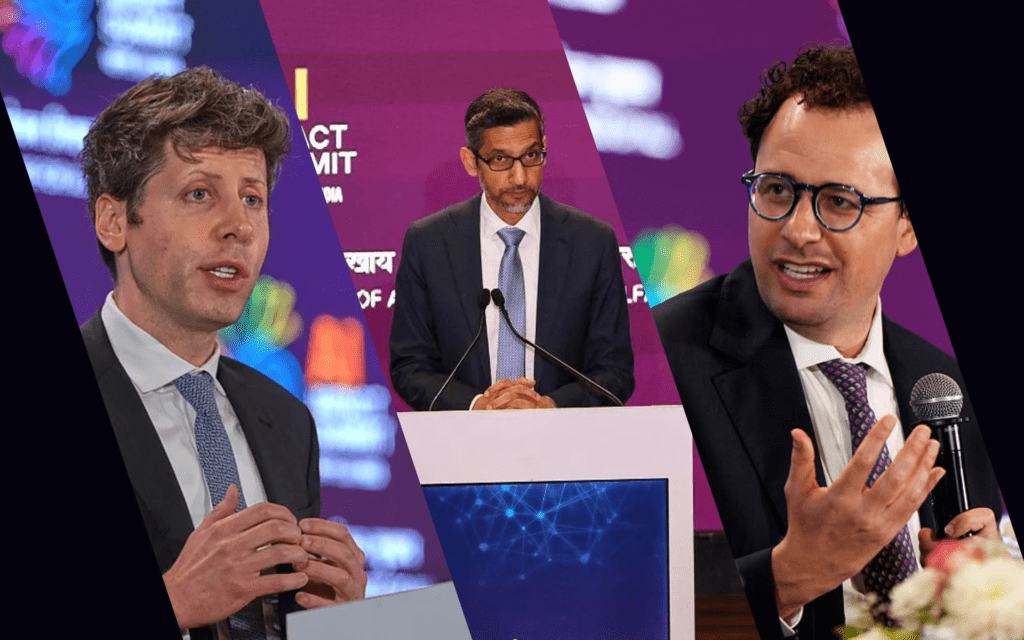
The speaker lineup was dense with heavyweight voices.
Sam Altman defended AI’s energy consumption with a memorable analogy: it takes “20 years of life and all the food you eat” for a human to become intelligent — AI learns far faster.
Sundar Pichai warned, “We cannot allow the digital divide to become an AI divide,” noting automation will eliminate some jobs while creating entirely new ones.
Dario Amodei of Anthropic spoke about AI’s power to lift “billions out of poverty,” but cautioned against risks of autonomous model behavior.
Demis Hassabis declared artificial general intelligence “on the horizon,” predicting transformation “ten times the Industrial Revolution” within a decade.
Vinod Khosla delivered the starkest warning: India’s IT services and BPO sectors could “almost completely” disappear within five years due to AI. His advice to young Indians was blunt — build AI products, don’t depend on service roles.
Wipro’s Rishad Premji described India as “the AI talent destination of the world,” citing approximately 60,000 AI professionals today — a number expected to double by 2027.
The optimism was bold. The caution was equally real.
Chaos, Credibility, and the Robot Dog

Yet for all its ambition, the summit stumbled.
Day One descended into crowd mismanagement. With approximately 250,000 visitors registered, Bharat Mandapam saw long queues, limited signage, water shortages, locked gates, and network collapses. QR registrations failed. Digital payments stopped working. Exhibitors were locked out of their own booths ahead of Modi’s arrival.
Mallikarjun Kharge called it “utter chaos.” Minister Vaishnaw publicly apologized and set up a crisis “war room.” A Bengaluru startup CEO even alleged patented AI wearables were stolen during the lockdown — though later recovered.
Then came the viral moment.
On February 18, Galgotias University presented a robotic dog, “Orion,” claiming it was built in-house. Within hours, social media identified it as the commercially available Unitree Go2 from China. India’s electronics secretary ordered the university to vacate its stall. The institution apologized, calling the claim “ill-informed.”
The incident went viral. Rahul Gandhi labeled the summit a “disorganised PR spectacle” and a “laughing stock.”
The contrast was sharp: half-trillion-dollar pledges on stage, and a credibility dent on the exhibition floor.
The Real Test Ahead
Analysts largely agreed: on balance, substance outweighed spectacle — primarily because the financial and diplomatic commitments were real.
But symbolism alone does not build compute clusters. Declarations do not retrain workers. Multilingual models do not automatically transform education.
The summit projected India as a Global South AI leader. It showcased ambition, investment, partnerships, and technological capability. It also exposed logistical fragility and the gap between aspiration and execution.
The phrase repeated quietly in post-summit commentary captured the challenge ahead: India must now turn “sutras and chakras into silicon and software.”
The India AI Impact Summit 2026 will likely be remembered as the moment India declared its intention to lead in artificial intelligence.
Whether it becomes the beginning of sustained transformation — or simply a well-staged announcement — depends on what happens next.
Not on the stage at Bharat Mandapam.
But in data centres, universities, startups, regulatory frameworks, and classrooms across a country of 1.4 billion people now deeply embedded in the global AI story.
Leave a Reply